The Ghost in the Machine: Why Your Best Ideas Die in Documentation
Every great product begins with a ghost—the high-context judgment and intuition that lives in your head. But our modern tool stack is built to kill it.
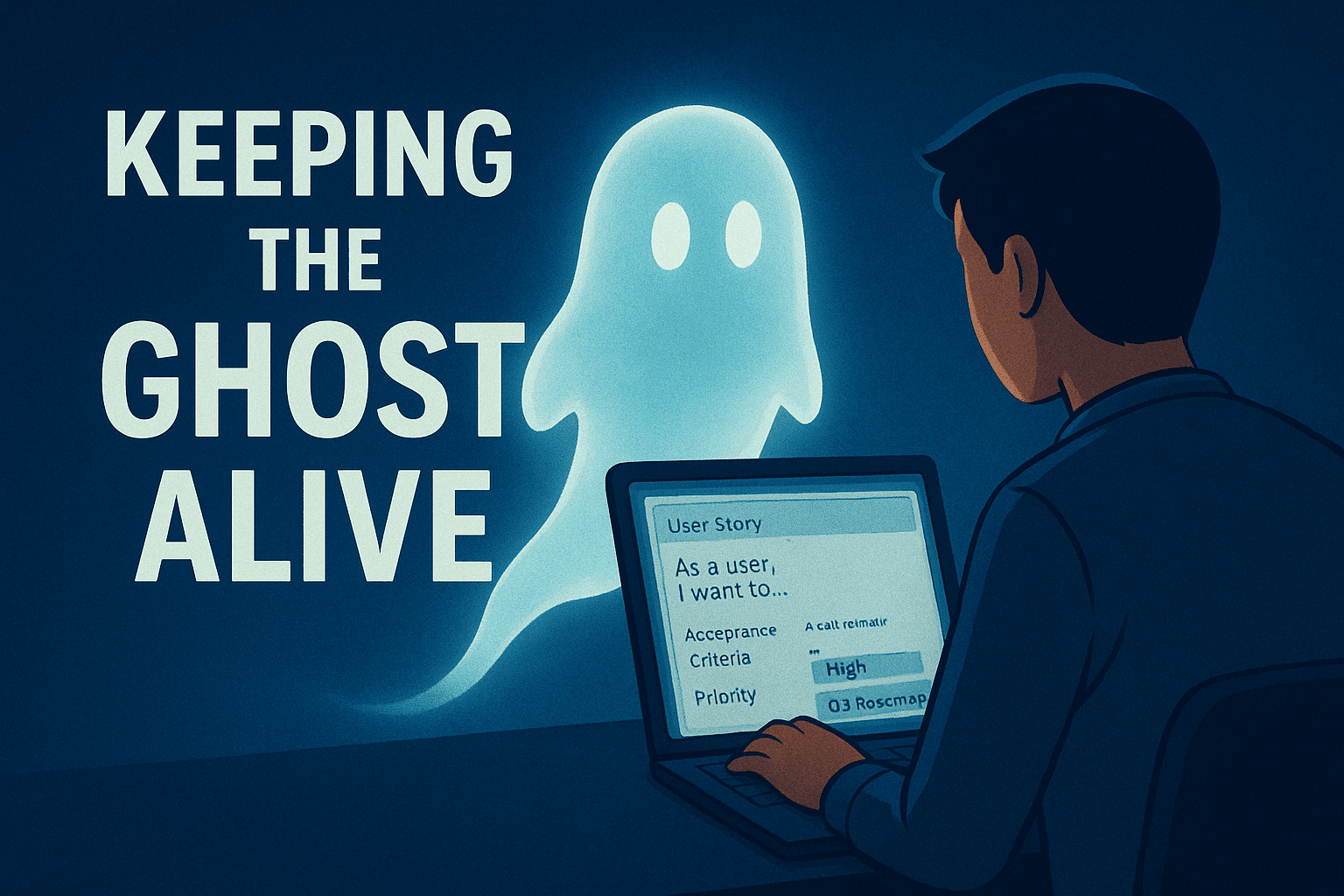
You get a flash of insight. It has a specific texture, a weight. You understand why it works, even if you haven't articulated the logic yet.
Then you open your project management tool. The cursor blinks.
- User Story: As a user, I want to...
- Acceptance Criteria: The system shall...
- Priority: High.
By the time you've filled in the boxes, the plan is defensible. The steps are actionable. But the feeling is gone. The idea is technically correct, but spiritually hollow.
What died in that translation? We call it the Ghost.
Defining the Ghost
In product building, we worship data and distrust intuition. But every great product begins with a ghost.
The ghost is high-context judgment. It is the constellation of subconscious observations, taste, and specific intent that lives in your head. It's the "vibe check" that tells you a feature is technically functional but emotionally cold.
The ghost is the why behind the what. And unfortunately, our modern tool stack is built to kill it.
How Tools Kill the Ghost
Most tools—Jira, Linear, rigid Notion templates—are designed for execution. They demand certainty. They require you to categorize and define ideas before they are fully formed.
When you force a fragile, spatial idea into a linear row, you strip away the context. You create a machine without a ghost.
The Jira Trap
Jira forces spatial, associative thinking into linear tickets. Your idea exists as a web of connections. But Jira wants:
- One ticket
- One assignee
- One sprint
The context—the why—lives scattered across Slack threads and memory. The ghost has no home.
The Stakeholder Framework
You learn to translate intuition into "defensible" business cases. But these frameworks are designed to make ideas legible to others, not to clarify them for yourself. You start performing certainty before you've achieved it.
The Template Tyranny
Notion templates and PRD formats promise structure. But early ideas don't need templates—they need scaffolding. When you force an embryonic idea into a rigid template, you're not clarifying it. You're embalming it.
The System Design Solution
We built Esono to solve this specific translation error. The goal was not to "generate ideas," but to engineer an environment where the ghost can survive the transition from mind to screen.
Spatial Over Linear
Most tools force you to think in rows and columns. But creative thinking is spatial—a web of relationships.
We designed a canvas that treats ideas as spatial nodes. This allows you to map connections and layer decisions over time. You can tag what stayed, what changed, and what died. This preserves the "ghost" of past iterations, making the why visible alongside the what.
Interrogating Intent
Instead of a passive text editor, we implemented an active interlocutor. The AI isn't a brainstorming bot; it acts as a thinking partner to interrogate your intent.
- "What are you protecting here?"
- "What would make this feel wrong?"
This forces you to articulate the feeling (the ghost) into language before it gets lost in requirements.
The Stillness Principle
The design philosophy is simple: protect focus, minimize context-switching, keep the ghost in one place.
By consolidating the thinking environment, we ensure the context—the ghost—has a permanent address, rather than being scattered across five different tools.
Keeping the Ghost Alive
You don't need specific tools to start protecting your ghost. You can adopt these system behaviors today:
- Name the Ghost Early: Before you build, write one sentence: "This idea feels right because..."
- Map the Invariants: After 3 iterations, ask: "What stayed true?" These are your ghost's fingerprints.
- Vibe Check Ritual: Before shipping, explain the idea to an imaginary friend. Does it sound like you, or a committee?
The ghost isn't a luxury. It is the work. It's the difference between a product that technically solves a problem and one that feels inevitable.
The question isn't whether you have good ideas. The question is: Are your tools letting you keep them?